


I feel privileged and lucky to have joined UNU-FLORES as a visiting researcher under the program because it has helped me broaden my understanding of the Resource Nexus concept.
About the program
The Joint Master's program (M.Sc — equivalent to M.Tech) on "Water Security and Global Change" is truly international, welcoming applications from candidates of all nationalities and exposing them to learning environments in both the Global South and the Global North on the critical and pressing issue of water security.
This new Master's program combines the expertise of all partner institutions to deliver an integrated and holistic approach, addressing the needs of regional, national, and international stakeholders. Existing modules serve as the foundation for the program, which adopts a modular structure featuring a mobility window for study abroad and options for specialization.
Courses are taught by experts from the participating institutions. Internships and Master's theses are carried out in close collaboration with selected companies, governmental agencies, and NGOs. Based on a jointly developed and implemented curriculum, the program is offered collaboratively by three degree-awarding universities — RWTH Aachen, IIT Madras, and TU Dresden — along with two associated partners, UNU-Flores and AIT Bangkok.
Curriculum
Outcomes
Experience
Structure
IIT Madras is offering 6 courses (4 Mandatory and 2 Elective), and TU Dresden and RWTH Aachen are offering 6 courses each (3 Mandatory and 3 Elective courses). The final semester is dedicated to the execution of a Master's Thesis with advisors from the partner universities.
Schedule
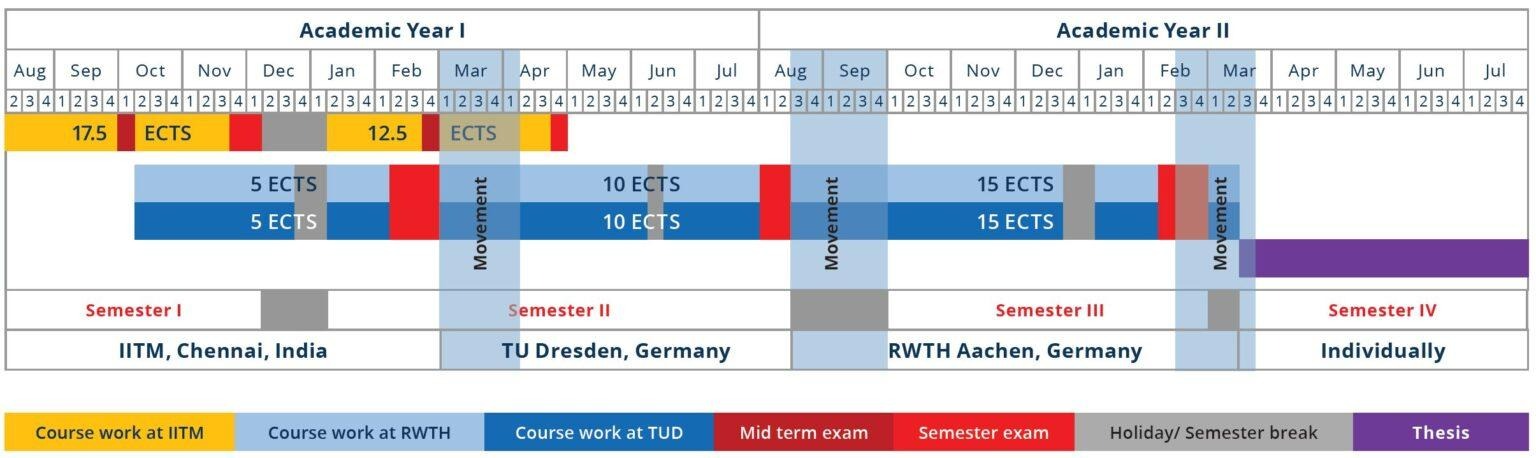
The Joint Master Program has a scope of earning 120 ECTS-Points / 213 IITM credits in total. It consists of three semesters of course work with 90 ECTS-Points / 159 IITM credits in total and a fourth semester of thesis of 30 ECTS / 54 IITM credits. Each semester consists of 30 ECTS-Points / 54 IITM credits of course work with courses of 5 or 7.5 ECTS-Points.
Thirty ECTS (51~54 IITM credits) per semester may change according to the agreed schedule (see above Program Timeline Table). Course work consists of mandatory and elective courses. Courses are offered equally by all 3 partner universities that sum up to 30 ECTS-Points / 53 IITM credits provided by each partner university. The programme enables to define up to 30 ECTS-Points / 53 IITM credits elective courses.
Courses
Requirements
Admission to the program may be granted to applicants who have obtained a Bachelor’s degree or an equivalent qualification that fulfills the following conditions:
Admissions
Complete the online application form. An application fee of INR 1,500 for Indian nationals and €15 for foreign nationals is applicable.
Await results of the initial review. Shortlisted candidates will be notified by email.
Shortlisted applicants enter a secondary process that may include online tests and interviews by the Selection Committee.
Selected students receive a formal invitation to enrol in the Joint Master's Program.
Fees
| Semester | Institute | IIT Madras (INR) | TU Dresden (€) | RWTH Aachen (€) |
|---|---|---|---|---|
| I | IIT Madras | 65,402 | 106.7 | 12.83 |
| II | TU Dresden | 38,000 | 304.5 | 12.83 |
| III | RWTH Aachen | 15,402 | 9.2 | 304.47 |
| IV.A | IIT Madras | 38,000 | 106.7 | 12.83 |
| IV.B | TU Dresden | 13,000 | 304.5 | 12.83 |
| IV.C | RWTH Aachen | 13,000 | 9.2 | 304.47 |
Notes:
Voices
I feel privileged and lucky to have joined UNU-FLORES as a visiting researcher under the program because it has helped me broaden my understanding of the Resource Nexus concept.

The support and guidance from the professors and fellow researchers at TU Dresden strengthened the quality of my research and broadened my perspective.

The IIT Madras campus impressed me with its beautiful natural setting and the unique experience of studying in such a lively environment.

Collaborating with highly experienced professors and fellow researchers proved instrumental in elevating the quality of my PhD thesis.